
 CAUTION: Never look directly at the Sun!
And never look at the Sun through binoculars or a telescope unless you have the proper
filters!
CAUTION: Never look directly at the Sun!
And never look at the Sun through binoculars or a telescope unless you have the proper
filters!
What's Happening in an eclipse?
A solar eclipse occurs when the Moon, during its monthly trip around
the Earth, happens to line up exactly between the Earth and the Sun so that it casts a shadow on the Earth.
But because of the Sun's large diameter, the shadow consists of two regions.
The innermost cone of total darkness is called the
umbra (latin for "shadow"),
and it is projected in the center.
Anyone in this central area will observe the
total eclipse,
because the Sun will be temporarily obscured by the Moon.
The outer shadow is partially illuminated by the Sun, and is called the
penumbra.
Anyone in this region will see the
partial eclipse, since the Sun is only partially obscured by the Moon.

If an eclipse occurs when the Moon lines up between the Earth and the
Sun, shouldn't there be an eclipse every month?
Solar eclipses do occur at New Moon, but not at every New Moon.
Most often the Moon passes a little higher or a little
lower than the Sun. There is a solar eclipse once or twice a year,
when the Moon's and Sun's positions exactly line up.
What's the Corona?
The glory of a solar eclipse comes from the dramatic view of
the Sun's corona, or outer atmosphere, which we can see only
when the brilliant solar disk is blocked by the Moon.
The corona is not just light shining from around the disk.
It is actually the outermost layer of the solar atmosphere.
Although the gas is very sparse, it is extraordinarily hot
(800,000 to 3,000,000 K), even hotter than the surface of the Sun!
The corona shows up as pearly white streamers, and their shape is determined by the Sun's current
magnetic fields.
Thus every eclipse will be unique and beautiful in its own way.
Solar scientists have been able to predict the shape of the coronal for our 2017 eclipse!
 Learn more the coronal prediction
How to observe a solar eclipse
When there is a solar eclipse, it is only visible from a small
area of the Earth. However, our 2017 eclipse will be visible to everyone in the United States!
However, only those along the center line (see map above) will see a total eclipse.
Others will see only a partial one.
Partial eclipses are interesting, but they don not allow you to see the Sun's corona.
You can safely observe a TOTALLY eclipsed Sun with your eyes.
However, for observing the beginning and ending of an eclipse,
or for a partial eclipse, you will need at least one of the following:
- Eclipse glasses
- A "pinhole camera":
Pinhole Camera
- A little SunSpotter telescope:
SunSpotter
- Welder's glass #12 or #14.
- A telescope with the proper solar filter!
For more on eye safety, see NASA's
How to View the 2017 Eclipse Safely.
For considerable detail on eye safety during an eclipse, see this resource from the American
Astronomical Society:
Solar Eclipse Eye Safety (By B.
Ralph Chou)
As you observe a total eclipse, try to imagine sketching the shapes and colors you see.
(Your camera will not be able to pick up these structures.) Look for the features below.
Also, avert your gaze frequently, since each time your eyes return to the spectacle, your brain will
(re)store the image!
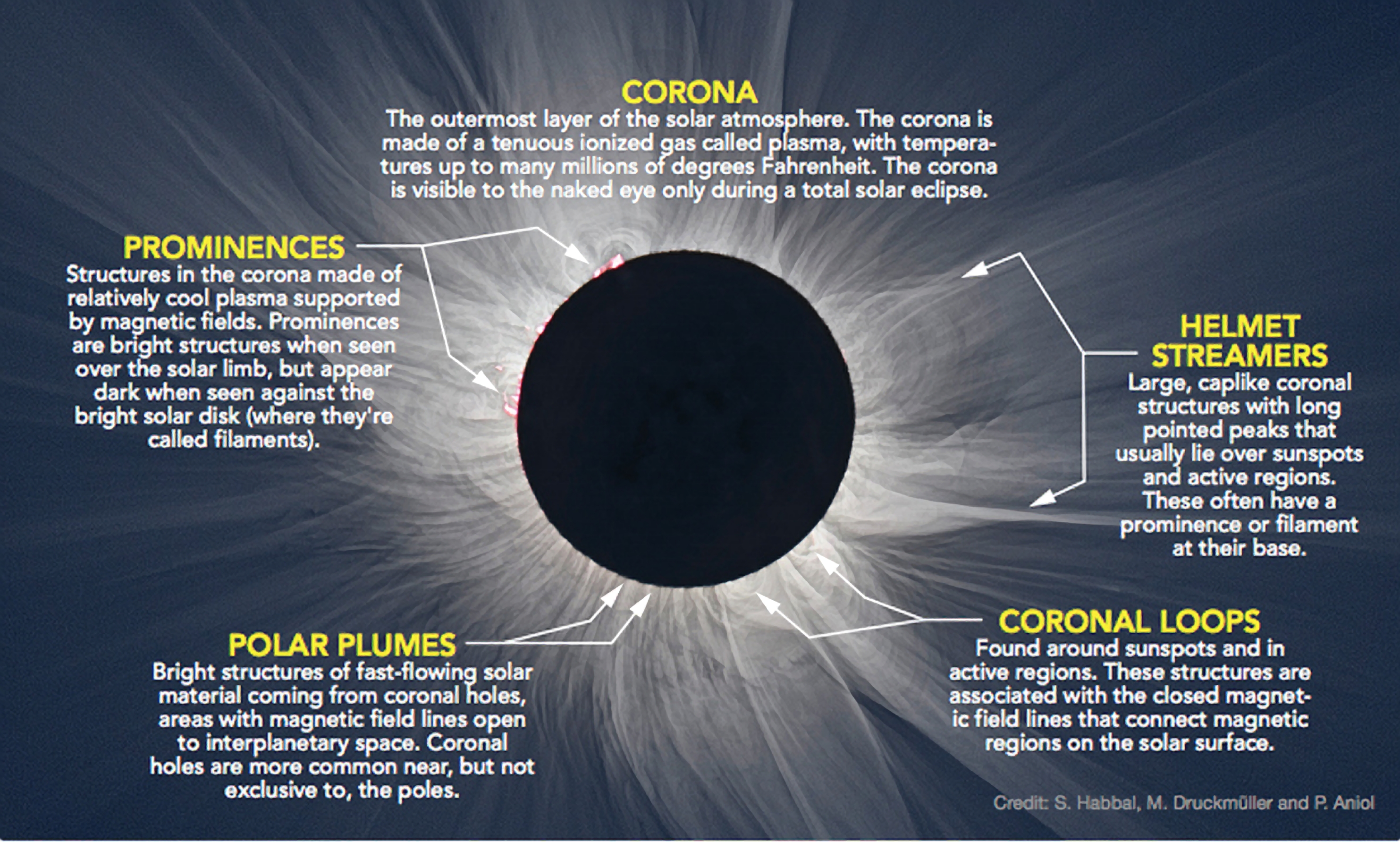
What to look for in a total solar eclipse
Solar Eclipse Resources










